Greetings HeroClix Masterminds!
Welcome to the first article exploring the upcoming DC Comics HeroClix set, Notorious! This all-villain set is our first MEGA SET: with 81 figures in the main set, and nearly 100 game elements to collect in total, we had the space to really dig into DC’s dark side and explore some of most nefarious ne’er-do-wells in comics. Over the next few articles, we slink our way through the set and showcase some of upcoming themes, mechanics, and design choices we made while working on Notorious.
When building a HeroClix set, lower rarity figures are one of the areas the design team puts a great deal of thought and care into. Common and uncommon figures are the backbone of sealed play and make up the majority of figures players will encounter as they open boosters. Low rarity figures define the feel of a set, and we knew an all-villain set would need a solid base to build off if we were going to capture the imaginations of players that might otherwise miss seeing their favorite heroes.
While there were several methods we used to ensure Notorious’ lower rarity figures were flavorful, the one we’re most excited to share is the Expendable Goon. The pages of DC Comics are filled with costumed henchmen, and giving players cheap goons to round out supervillain teams was a great way to make players really feel like a dastardly mastermind. To that point, we noted that there were four goals our Goons needed to hit:
-They needed to be inexpensive, so players could field many at once.
-They needed to be generated, so “boss” characters could call out more goons as the battle progresses.
-They needed to support their boss’s gameplay.
-They needed to do all of the above, while also being simple enough in play to justify being at a common rarity.
A problem quickly emerged while trying to hit all of these: While summoning goons was fun, hanging that complexity on their bosses was making the boss characters feel too similar. Having Riddler, The Joker, Penguin, and the rest all rolling to generate their flavor of costumed goon felt like trait text that would have been better spent giving those characters their own unique identities.
Finding solutions that made sense to these design challenges was tricky, and we had to work through a couple ideas before we found the perfect one that we liked. Ultimately, one of our designers noted that there are plenty of canon examples of goons talking about working under different bosses; while one of The Joker’s goons might not be in the same costume he wore when working for Riddler, he could certainly have some tricks he picked up from that job. This let us standardize an “Expendable Goon” trait where as goons got KO’d, they could self-generate replacements; villains are all hiring from the same group of criminals, after all… If we restricted the generation to a success roll so that goons weren’t an infinitely replenishing resource we could then use the fail state of that roll to give a bonus to whatever their boss character is. For example, the Joker Goon:
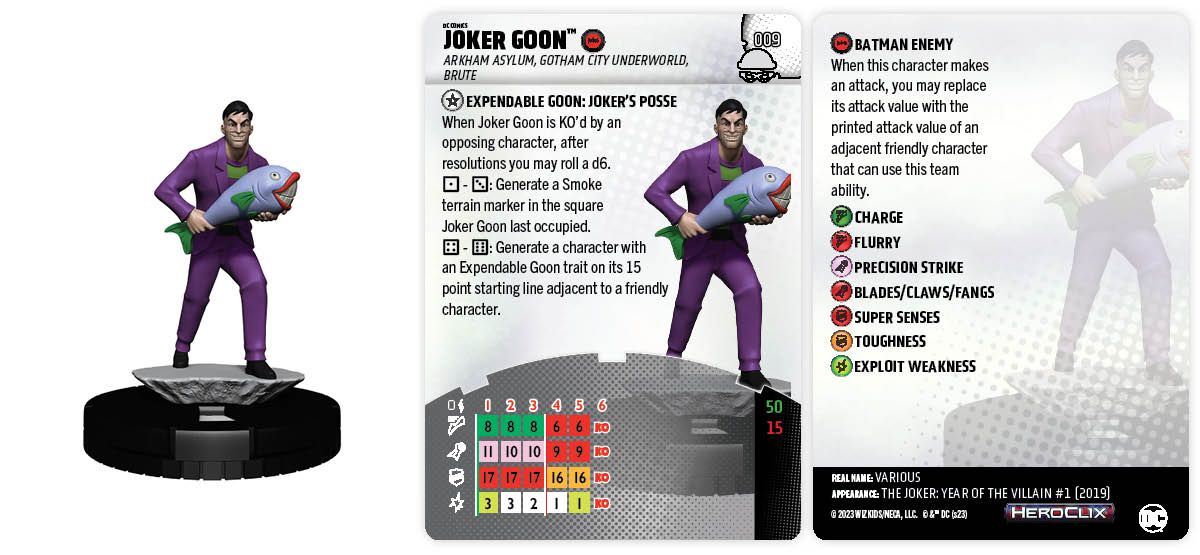
When Joker Goon is KO’d he’ll either leave behind permanent Smoke terrain this set’s Joker can use to his advantage, or bring in any Goon; be it another one of The Joker’s posse or a henchman freshly poached from Black Manta’s crew or Riddler’s gang. With their cheap costs, flexible generation, and unique KO effects we’re excited to see what teams players come up with using Notorious’ Goons!
Speaking of The Joker,
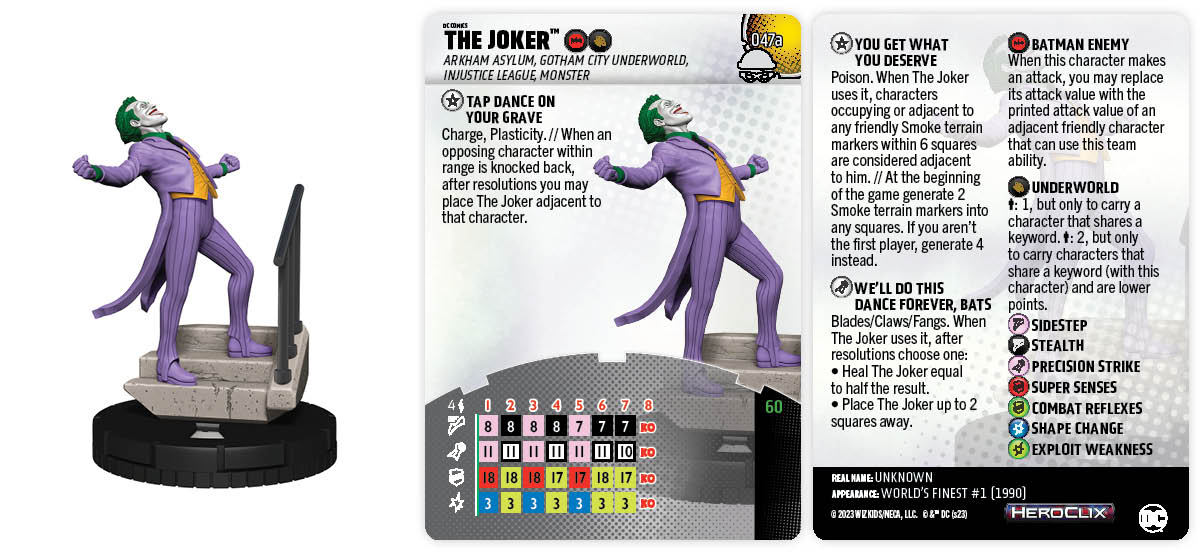
The Joker’s “You Get What You Deserve” showcases both the interaction with his Goon and a “Go Second” mechanic that is woven throughout Notorious. All the best villains have their own secret lairs, and “Go Second” let us capitalize on that in a fun way. If you choose the map, your villainous masterminds can convert that map into a proper trap-filled hideout. For The Joker, that means clouds of toxic Joker Gas. Other characters could have their own terrain, or possibly other ways to tweak the map or starting forces.
Moving now to the opposite end from the commons, we have the chase figures. Chases have a much higher complexity budget than commons, allowing us more room to employ dynamic, flavorful abilities. In Notorious we got a chance to put a monstrous spin on some of DC’s famous heroes, and DCeased was one of the stories we were able to draw from. In the story, Darkseid completes the Anti-Life Equation and creates a techno-organic virus that corrupts those exposed to it into rage-fueled zombie-like monsters. Zombie storylines like DCeased are among the themes we get the most requests for, and they’re always fun to dig in to. So without further ado, Superman:
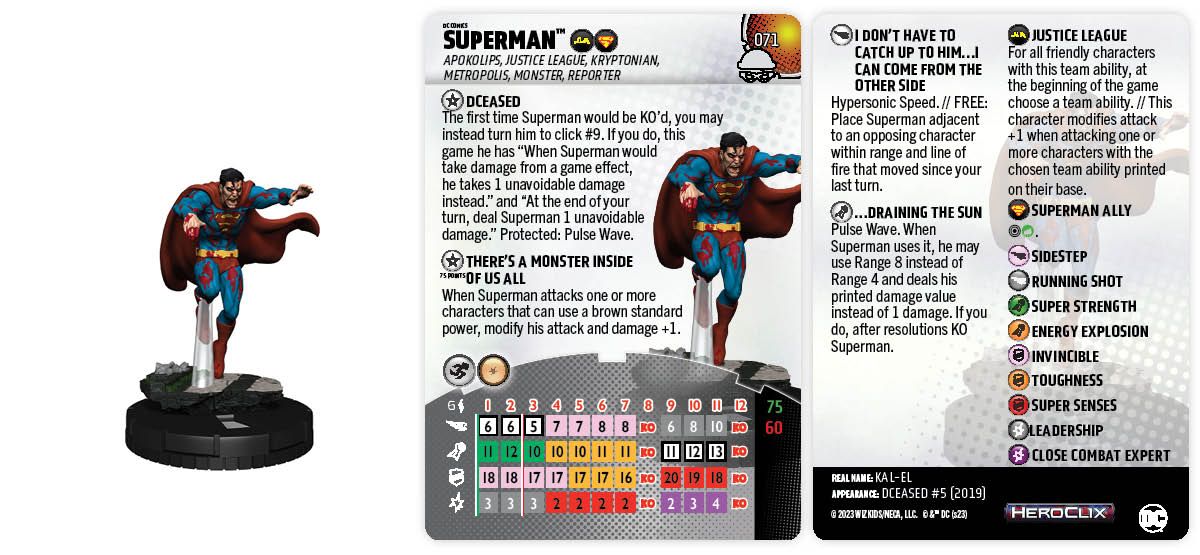
All DCeased characters share the DCEASED trait, and open with a standard “living” take on the character. However, the first time they would be KO’d, the Anti-Life Equation takes over. Their combat values go up and they become resistant to damage, but they’ll quickly burn themselves out. From a design standpoint, that last point was interesting to design around. By putting these super-charged zombie clicks on a clock, we were able to turn up the power level on them and play with more potent effects than we would normally use on a character. It poses an interesting question to the player: Do you embrace the power DCEASED offers, even though you risk your opponent’s team weathering the storm?
We’ll leave you to consider that. Join us next time as we look at new terrain, new assassin mechanics, and new tweaks to favorite team abilities.