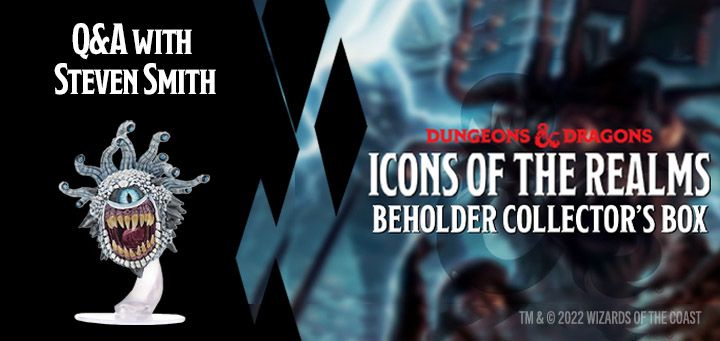

Q: What inspired your vision for the Beholder Collector’s Box project?
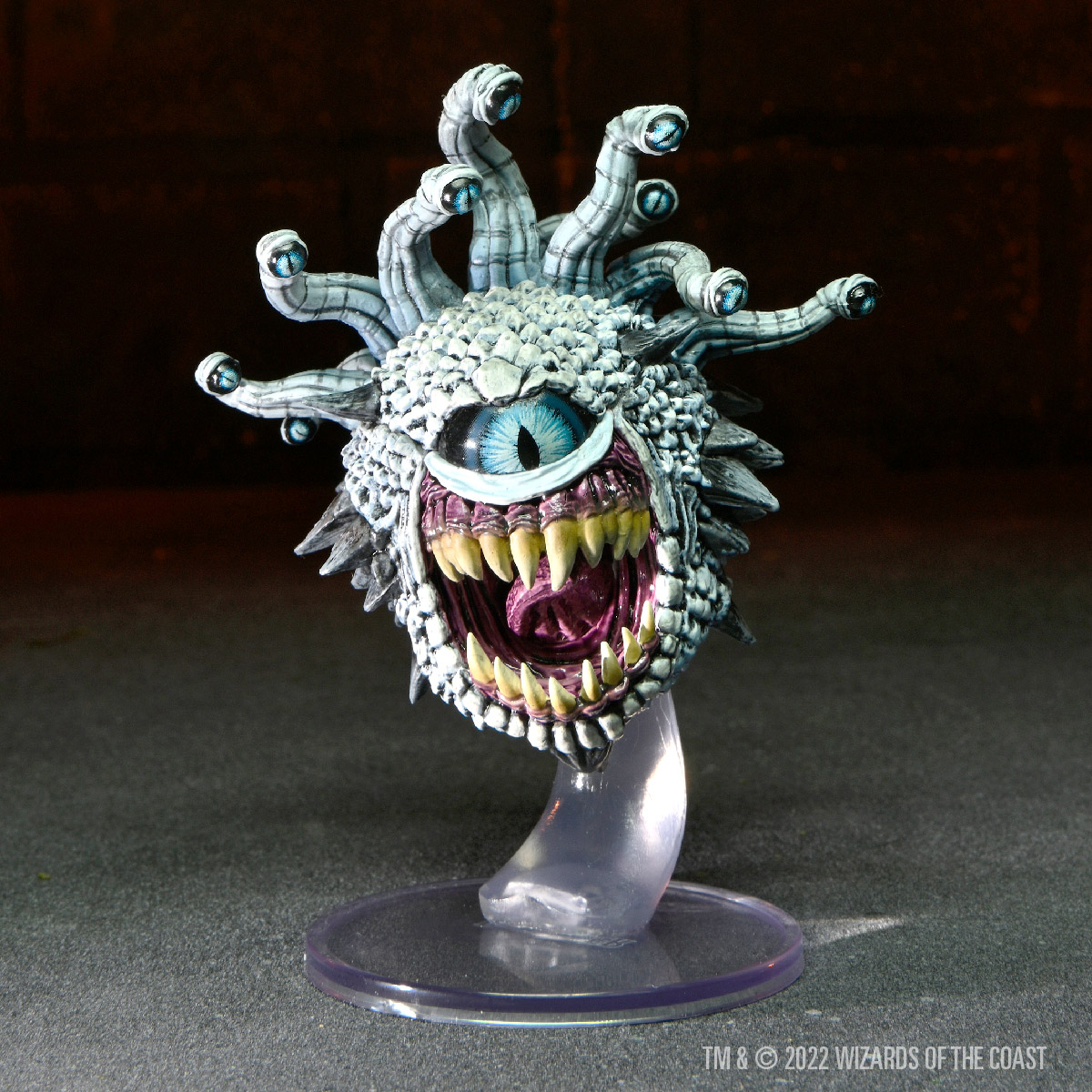
My beholder was inspired by a certain blue-eyed villain in pop culture. I’ve always enjoyed the beholder variants in D&D, so that initial inspiration aligned with the Eye of Frost Beholder (from previous editions) rather easily.
Q: What makes the Beholder such a fun model to paint?
The WizKids Beholder is one of the most versatile models on the market. It is a blank canvas that can be painted in infinite ways, which really aids the re-paintability and encourages you to paint multiples. It’s simple yet evocative, and it lets the individual’s creativity shine.
Q: What are some techniques that define your style?
Layering is foundational to practically every other painting technique, so it’s probably my most-used technique. That said, my style is often described as clean and contrasty, so I also use lots of glazing and dark lining to create clean gradients and poppy separation of parts.
Q: Tell us about your creative process – do you start with a plan and stick to it or let the model guide you along the way?
My process varies with each project. Sometimes I will match a piece of concept art, so that serves as a very specific plan. Other times I will look for inspiration in other traditional artwork (either from the Monster Manual or from images on the internet), and that may guide my initial color selection and placement. Many projects are also simply based on a vision I have myself. However, each project inevitably transitions to a “feel” phase where I need to alter the plan as I go. There are always many routes to take that will arrive at the same destination or vision.
Q: What advice would you give to new miniature painters?
Just paint! Get lots of reps, and don’t be afraid to try new techniques that seem scary, because that’s the best way to improve. Watch videos on YouTube, sure, but make sure you go and actually DO those things yourself! Practice doesn’t make perfect, because there’s no such thing (especially in mini painting), but it definitely makes PROFICIENT. The other hang-up I commonly hear with new painters is “I don’t want to paint that model yet because I’m afraid I’ll ruin it.” There are two issues with that. First, it’s just paint! You can always paint over it or, in extreme situations, strip it and start over. Second, you are more likely to paint and get reps if you’re excited about the model you’re painting. If you’re really excited about that dragon model, paint it! Even if it doesn’t turn out the way you envisioned, you likely enjoyed the process and learned lessons you can use on the next one.
Q: Do you have a favorite D&D memory?
Playing as a cleric (the best class) in a friend’s campaign, I dealt over eight hundred damage with a single up-cast of Spirit Guardians. I hit sixteen enemies weak to radiant damage and absolutely wrecked the encounter (sorry Charlie). A more character-driven memory is a long-term campaign where my wizard secretly lived as a werebear unbeknownst to the other players. The first “public” transformation and subsequent homebrewed mastery of the power were incredibly rewarding (thanks Alyx!).
Q: What would you do if you encountered a Beholder in real life?
Cast Expeditious Retreat and run far away! The fight, flight, or freeze response would be strong there!