Iconic Heroes Set 7 is the latest release in the Pathfinder Battles series of pre-painted plastic miniatures from WizKids and Paizo Inc.

72400-iconic-heroes4-1

Pathfinder Battles: Iconic Heroes Set 7

Overview

Pathfinder Battles: Iconic Heroes Box Set VII includes five all-new miniatures featuring famous personalities from the Pathfinder role-playing universe: Erasamus, Yoon, Mavaro, Estra, and Honaire! Each of these miniatures is an all-new sculpt and will feature a dynamic pose, incredible detail and a premium paint job.


Notice: There is a known error on the packaging that references seven figures in the set, the solicitations and the ability to see all the figures in the packaging confirms there are only five.

MSRP: $29.99   
SKU: 72400

Details

Release Date November 2017
Game Time 2+ Hrs
Ages 14+

All Characters – Set 7

kineticist-masked


Yoon
Human Kineticist

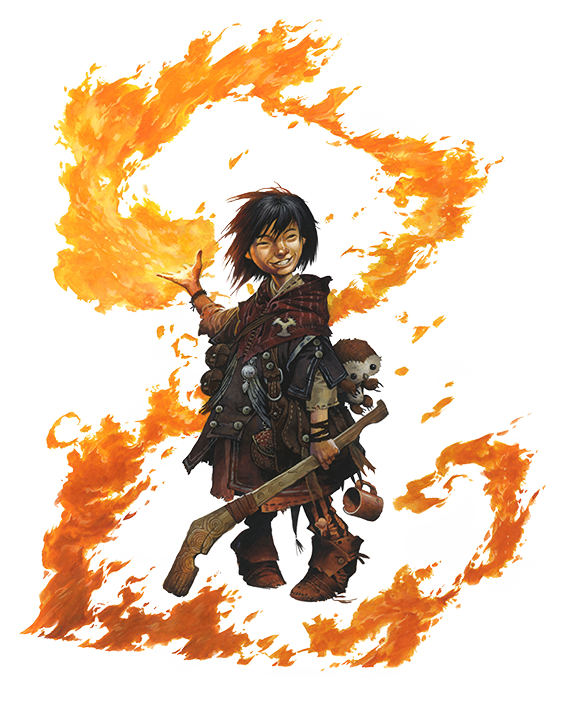
Yoon always loved fire—the warmth, the color, the brilliant blaze. Fire always changed, and changed everything around it. Yoon could empathize. Fire was also always hungry—Yoon could empathize with that, too, as her family were immigrants in Minkai, and struggled to support themselves.

Not long after Yoon learned to walk, she learned to climb, and immediately took a shining to the rooftops of Oda. Her father only brought her to the city for the big festivals, and she wanted the best view to watch the fireworks celebrating the Lady of the North Star. Once, when she was climbing, Yoon fell, dropping into the river, and her father had to fish her out. Yoon coughed up a seemingly endless stream of water, and her grandmother scolded her, saying it would have been far worse if Yoon had hit the ground.

Yoon wasn’t so sure. Just as fire had always been her friend, water had always been her enemy. All her life, it had taken her mother away on ships, for weeks or months at a time. And in the end, it refused to give her back.

Yoon’s mother had been a brave warrior and explorer, and had told Yoon many fantastic tales of adventure and faraway places, primarily in the savage lands to the north. She also brought Yoon things, like the stuffed bear-owl creature named Gom-Gom, or the crooked stick used to play a strange northern game. Yet one day, her mother failed to return. Yoon and her father waited, growing more anxious as each week. When at last a messenger arrived and confirmed her mother’s death battling siyokoys, a grief-stricken Yoon decided that no one else would ever call her by the same name her mother had. Forsaking her old name, she insisted on being referred to only by her mother’s family name, the one her mother’s adventuring companions had called her—Yoon.

Gom-Gom was the first to accept Yoon’s new name. Eventually, even her grandmother gave in, though she continued to sniff at the impropriety. Yoon’s grandmother had been a palace servant to the Shojinawa family once, and despite the fact that Yoon was determined to become a warrior like her mother, the old woman insisted on teaching her about things like poise, discipline, and self-control, arguing that they were just as important to a warrior as to a court scholar. Yoon didn’t quite believe that, but did her best anyway, proving a quick and capable student.

Yoon’s father fared worse. Still a loving, caring parent, he grew distant and sad after his wife’s death, and spent more time muttering about things like imperial taxes and yakuza corruption. The new friends he made were constantly grouchy, and Yoon came to think of them privately as his Bitter Friends. They spent long evenings drinking and arguing in low voices, always careful to keep the windows closed and doors locked, even in the worst summer heat.

One night, as Yoon was once more watching fireworks in honor of the Lady of the North Star, her father went off to meet those friends. Yet even as the colored stars burst overhead, a new light blazed up to the east—a burning warehouse! Yoon went to watch the citizens fight the fire, but when she arrived, she found the place surrounded by imperial soldiers. Not only were they not helping put out the blaze, they were actively preventing those inside from fleeing. An uncomprehending Yoon wept to hear their cries, plugging her ears against the crunch of tetsubos on bone as the soldiers beat back burning men and women and their captain issued a proclamation about the punishment of Hwan rebels.

That’s when Yoon saw her father.

He was in a knot of his Bitter Friends, blackened with ash, struggling to break through the ranks of soldiers. Even as Yoon called his name, she saw him fall beneath the soldiers’ blows.

Screaming, Yoon raced for the line of soldiers. She might have gone unnoticed in the din, if not for the flaming board she scooped up and hurled at one of the soldiers, striking him in the helmet. As the man crumpled to the ground, several of his companions turned toward her. Yet as they advanced, truncheons raised, Yoon found her view suddenly blocked by her grandmother, wreathed in a snaking cloud of eerie black flames.

“Run, child!” the woman commanded. “If you listen to me only once in your life, run now, and don’t come back!”

Yoon ran—through the city, out the gates, and into the surrounding fields. Only when she could run no farther did she finally collapse, exhausted, into the grass, listening to the night breeze and the song of insects. Behind her, the fireworks still continued, but the brilliant lines and stars no longer held Yoon’s attention. As she held up a hand, little flickers of black flame flared into life around it. Her own tiny fireworks.

Her grandmother had commanded her to leave. Yoon understood that. She had struck a soldier, and no one harmed an imperial soldier and lived. But where should she go? She had always wanted to see Hwanggot, her family’s homeland, but it lay across the water to the southwest, and there was no way Yoon was crossing that much water. In a sudden flash of inspiration, she decided to head north, up through the Forest of Spirits, then down along the mainland. She would be an explorer, like her mother. And she wouldn’t have to be scared. After all, she still had her two oldest friends—Gom-Gom and fire. Between the two of them, they’d protect her.

Yet while a stuffed animal and a magical flame can handle a lot of problems, they weren’t truly equipped to handle all Yoon’s needs, and she might well have starved to death in the ensuing days and weeks if she hadn’t fallen in with a mysterious traveler. Seemingly waiting for Yoon at a crossroads, the man spoke to Yoon of her powers, helping her come to understand them even as he taught her to scavenge and forage for food. Yet his greatest gift came on the slopes of the great volcano Kumijinja, where he called forth the spirits of the mountain’s fire, presenting Yoon to them like a visiting dignitary. As the kami touched her, Yoon felt something inside her shift, and the flames that roiled inside her emerged, turning from black to a brilliant red. In that instant, she understood the fire she carried, and it understood her. When she woke from her trance-like reverie, the traveler was gone, leaving Yoon to continue her journeys alone—a child in age, yet armed with the courage of her mother, and the fiery wisdom of the mountain.

039_yoonhumankineticist_hiresrender


Erasmus
Human Medium

Erasmus was born the youngest scion of a minor noble house in Caliphas, Ustalav’s capital. Along with his five older siblings, he enjoyed the benefits of a fine education and practice in horsemanship, swordplay, and tutelage in the arcane arts. Yet he understood he had little hope of ever claiming ancestral holdings or heirship. He spent his early life in the cosmopolitan pursuits of the idle rich, and he seemed destined for some opportune marriage to secure his family’s comfort, with the resulting life likely to be one of bored leisure.
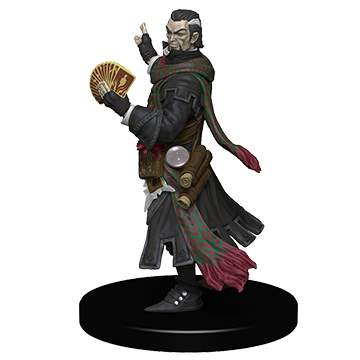
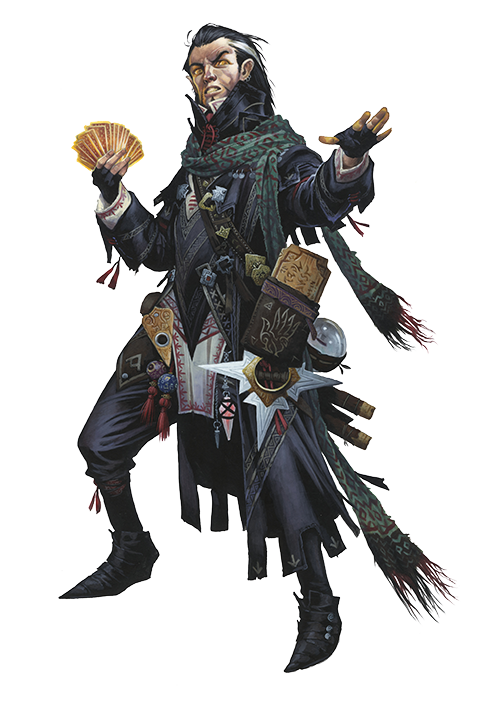
As Erasmus left his teenage years behind, though, the heirs of his family began to mysteriously die. Authorities discovered Nissa, his eldest sister—a cunning duelist—slain in some underground fighting pit by an opponent she severely outmatched. His uncle, a skilled magic-user, was torn apart by a summoned creature in his own occult library, while the corpse of his son was found broken below his high tower. His second sister, Veldira, choked to death on porridge in the Pharasmin cathedral where she served. Erasmus’s closest confidant, his sly older brother Baylock, was found hanged in a dark alley in what authorities ruled a suicide. Amid the turmoil of the deaths, Erasmus’s father began to waste away in his council chamber, while the family’s eldest surviving heir, Erasmus’s brother Vinn, took control of the family affairs.

It wasn’t long before the voices started.

At first they were the faintest whispers, which Erasmus dismissed as sleep-deprived hallucinations or echoes bouncing through the corridors of his family’s estate. But with each new death, the whispers grew stronger and their message clearer: “Murder.” Erasmus ignored the ghostly mutterings as best he could, quietly writing them off as the lunacy of grief. But, with his suspicions aroused, he began to investigate the whispers’ claims. Erasmus told no one of the subtly altered summoning circle he found in his uncle’s chambers, or of the oily residue that failed to wash from his father’s used silverware. The more he discovered, the more intense the chorus of voices grew in his crowded mind. Servants concealed Erasmus’s late-night wanderings as best they could, or dismissed his mutterings and wild ravings as overwhelming grief.

It all came to a head when one of Erasmus’s episodes interrupted his own father’s funeral. Snapping his head back and forth, Erasmus railed against a chorus of unseen phantoms. Amid the outburst, he howled that his family was victim of his eldest brother’s deceit.

None who heard truly listened, though, all convinced that grief had pushed Erasmus past the brink of insanity. Vinn, Erasmus’s only remaining family member, committed him to Havenguard Lunatic Asylum.

For nearly a year, Erasmus languished at the asylum, baffling his well-intentioned wardens as they sought to heal the man’s troubled mind. But on the anniversary of his father’s death, another voice called through the darkness. From a neighboring cell, a new prisoner calling himself “the King” counseled the troubled man. With gruff kindness, the stranger with the accent of a northern barbarian taught Erasmus not to fight the chorus, but rather to accept and welcome it, opening his mind and body to its words. Erasmus gradually identified each mysterious voice in turn, and finally understood they were the shades of his family—the spirits of his deceased brothers, father, and uncle—who endlessly dwelled upon the circumstances of their deaths. Over time, he learned to sit in quiet communion with the voices, and to allow them to exercise their influence upon his mortal shell.

With the aid of his uncle’s mastery of magic, Erasmus easily retrieved the keys to his cell to secure his escape. Under the control of his battle-eager eldest sister, the asylum’s guards had no hope of restraining him. But when he gratefully burst open the King’s cell, he found it empty. Too harried to ponder the implications of his friend’s disappearance, Erasmus fled, relying on the influence of his roguish brother Baylock to slip through the shadows to freedom.

Yet, the world had not changed for the better during Erasmus’s absence. Vinn had used his brother’s madness to legally disown him from any claim to his family’s titles or lands. His murderous brother had also married into a prestigious noble family, solidifying his holdings and winning him considerable influence in Caliphas’s royal court. Seeing little chance at justice, and now questioning the source of the mysterious voice that had counseled him back to sanity, Erasmus knew he’d need living allies to retake his birthright. He boarded a ship crossing Lake Encarthan, the restless spirits of his ancestors following close behind.

038_erasmus_human_medium_hiresrender
medium-masked-no-sig
occultist-masked-no-sig

Mavaro
Human Occulitist

Mavaro’s earliest childhood memories are of the silent seclusion of a Pharasmin convent deep in the Mindspin Mountains. The boy never learned what brought his mother to the strange cloister built among ancient standing stones, but there she had sought refuge. The sisters’ strict tutelage was the only life he knew; his only friends the esoteric books and scrolls of the convent’s great library. He spent years in the library, devouring countless tomes to learn more of the world denied him.

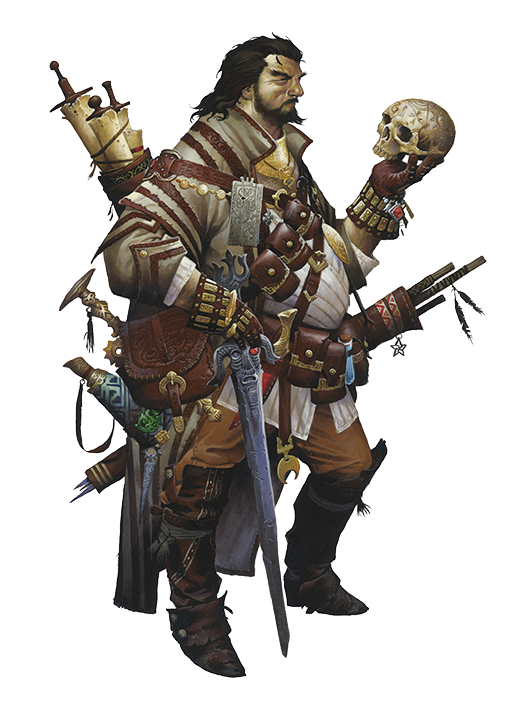
Tales of horrors stalking the cloister’s corridors held Mavaro’s wanderlust in check. As he grew older, Mavaro dismissed the stories and learned to secretly navigate the forbidden halls of the convent, where he regularly bore witness to the nuns’ strange ceremonies. One was a ritual of severe fasting and meditation that gradually wasted the sisters’ bodies. After a period of fasting, novices would unveil a yellowed, sigil-scripted skull of the order’s founding abbess, Mother Wren. The acolytes then listened in turn for a ghostly whisper from the skull to indicate a worthy candidate. Soon afterward, the selected nun’s sisters would rise to adorn the candidate’s body, withered in self-starvation, with strange sigils and specially cast silver talismans. They’d wrap her in fresh linens and carry her down into a hidden, spiraling catacomb to carefully place her among generations of similarly mummified worshipers spanning thousands of years.

In Mavaro’s twenty-second year, Varisian traders arrived at the abbey. While the nuns took the opportunity to restock their food stores and other essentials, Mavaro felt entranced by a wagonload of riches reclaimed from the ruins of a stone giant temple. Tribal totems, esoteric steles, and ruined relics of forgotten cultures all called to him—representations of a world and cultures he’d only ever read about. When one of the traders pulled forth a strange sword of ancient design, bearing a carved, glowering face with gleaming red gems inset as eyes, Mavaro knew he had to obtain the treasures at whatever cost.

But as only a lonely scribe, Mavaro had no way to pay for the items. So he quietly stole into the forbidden catacombs where he knew the silver talismans of the abbey’s mummies lay for the taking. Little did he know, though, that the sisters’ starved bodies actually served as unwavering guardians, and with the desecration of their remains, an evil long held in check by their sacrifice slipped free. As the caravan trundled away from the holy ground, taking the convent’s traded relics with it, the binding magic that held the entity in check cracked imperceptibly, and its spiritual corruption leaked forth.

The deaths began slowly. At first they just seemed like bad luck: a broken neck from a short fall; a drowning in the convent’s well; three nuns killed in the collapse of an old stone wall in the kitchens. But soon the malevolent presence grew more bold, and the sisters realized something was hunting them in the quiet corridors. By the time the prioress realized that Mavaro’s pilfering had jeopardized divine defenses centuries in the making, it was too late. One by one, the nuns were slaughtered by the dark thing of rust and chains slipping through their midst. The quiet butcher saved the prioress for last, possessing her body in anticipation of a long, self-inflicted torment. But wrenching back control of her body for the briefest moment, the prioress knocked a lantern aside and set fire to the convent in an attempt to destroy the entity—and herself—in cleansing flame.

Though injured, the vicious entity was not destroyed in the blaze, and only it and Mavaro survived. Desperate to protect himself, Mavaro shifted through the smoldering ruins of the haunted abbey, desperately collecting any holy relics he could find in hope of warding off the lingering evil. Vestments of razor wire still glowing red, the spirit soon found Mavaro. The young scholar would surely have faced his death, had not the skull of Mother Wren whispered to him from the ashes. The ancient holy woman commanded Mavaro to close his eyes and open his soul to the power of the items he had collected. Its long fingers flicking like the lashes of a scourge, the wicked shadow closed on the desperate youth, cooing promises of endless, barb-licked torment. Mavaro felt the power of the relics well up inside him, and shakily reached for the ruby-eyed blade he had purchased. Trembling, but full with strange power, Mavaro blindly struck.

A red gem shattered in the sword’s hilt and the dark thing shrieked, flailing jangling fetters as it retreated through the ruins. Mavaro fled the holy site as quick as he could, never looking back at the only place he’d ever called home.

In the twenty years since, Mavaro’s life has been a strange paradox. He’s now a man of many indulgences, making up for his modest childhood with good food and raucous company. He deflects inquiries about his youth with inconsistent but highly entertaining tales tied in with his mysterious collection of relics and strange objects. Quietly, though, he regularly casts one eye over his shoulder, ever watchful for the shadow he’s come to call the Thorn Priest, which stalks him still. Mavaro regularly consults the yellowed skull of Mother Wren, heeding her ghostly whispers as he pursues the relics he traded away long ago. His travels have taken him to markets across Varisia, the strangest of private collections, and many dangerous, distant locales. Still he seeks to reclaim their power, determined to undo the folly of his youth and face the Thorn Priest once more.

040_mavaro_human_occultist_hiresrender

Estra
Human Spiritualist

Honaire
Phantom

Estra never wanted to commune with spirits: she only wished for others to believe she did, and profit from that belief.

Born the daughter of a poor miner in the nation of Isger, Estra dreamed of the theaters of far-off cities, and more than once nearly ran away with a traveling acting troupe that stopped in her small town. Fortunately, her family moved to the capital city of Isger, Elidir, during her teenage years, and she swiftly became enthralled with her new, cosmopolitan home. Her dreams of joining the theater were even somewhat fulfilled when she fell in with a small gang of faux-spiritualists who needed a convincing actress to play the role of their spirit-channeling medium. The group engaged in fraudulent séances targeting grieving mourners, who paid dearly for confirmation of the smooth passing of their loved ones into the hereafter.
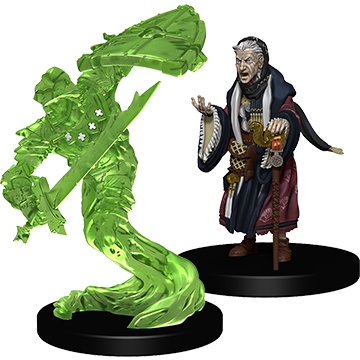
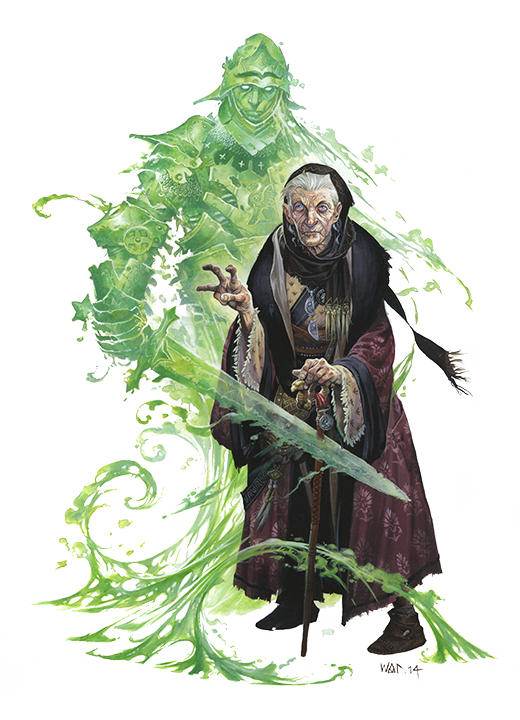
Within darkened chambers and ramshackle theaters, Estra and her confederates spent nearly ten years bilking grief-stricken with the promise of communion with their dead relatives. Estra proved a talented actress, falling into convincing trances to channel the dead and dispense the carefully gathered information her associates had gleaned on their targets. Sessions typically culminated with the full-form “manifestation” of a bereaved subject’s lost relative: actually a confederate dressed in luminous robes and clumsy disguises approximating the dead person’s appearance.

The arrival of a handsome knight named Honaire changed all that. Stationed in Elidir, Honaire had left behind an ailing mother, and in his absence she had passed. Honaire sought some comfort in his loss, and turned toward the séances of Estra’s troupe for assurance that his mother rested in peace. Relieved of his grief by the assurances of the spirit-seer, the young knight became smitten with Estra’s quick wit and streetwise charm. Estra, for her part, found the knight’s combination of physical strength and gentle courtesy enchanting, even as his strict code of honor made her regret her own life of lies. When at last she confessed the truth—that she’d never contacted Honaire’s mother at all—she expected him to fly into a rage. Instead, he thanked her for her courage, and promptly proposed marriage. Accepting his proposal, Estra left behind the life of a charlatan, and the two spent several happy decades together, with Estra enjoying the social status that came from being the wife of an up-and-coming military commander.

Yet this life, too, came to an abrupt end when rumors of a rising alliance of goblin tribes reached the capital. Seeing her husband’s frustration at the government’s slow response, Estra urged him to volunteer to investigate, with no way of knowing that the goblin assemblies were in fact the precursor to the deadly Goblinblood Wars. There in the dark expanse of the Chitterwood, Honaire and his unit were unexpectedly ambushed by a horde of maniacal goblins and their green dragon ally. Though he fought bravely and saved the lives of many comrades in their retreat, Honaire was bathed in the dragon’s toxic breath, his armor and body rent by the beast’s deadly claws.

Wracked by guilt and loss, set adrift in a devastated nation that suddenly had more to worry about than the plight of military widows, Estra turned back to her old means of supporting herself, training several new associates in the tricks of the faux-spiritualist trade. Yet during the group’s first performance, while her confederates secretly lifted spirit trumpets with thin threads and caused tambourines to shake as if by unseen forces, Estra’s fake trance became something more. A wispy, greenish vapor coalesced from her mouth, eyes, and nostrils. To the wonderment of those assembled, a spectral figure emerged through the curtain of ectoplasmic mists. The ghostly apparition was not the luminous confederate Estra expected to emerge from the spirit cabinet, but rather the very real specter of her fallen husband. Both comforted and shamed, the burgeoning spiritualist pledged once again to never allow deceit to rule her life.

Though her body is increasingly stooped by age, Estra has learned to strengthen her spiritual bond with Honaire so that his ectoplasmic form might walk the world again. She tries to emulate her lost lover’s selfless drive to aid the helpless wherever they might be afflicted—though her impatience and sharp tongue sometimes get the better of her. Wandering far from Isger, she uses her strange powers to provide comfort and consolation—for real this time—to those who’ve lost loved ones to the ceaseless violence of the world. Yet all the while, she remains plagued by doubt, wondering if her phantom husband’s presence is the result of the depth of their love, some god’s attempt to shepherd her toward righteousness, or a manifestation of her own guilty conscience.

041_estra_human_spiritualist_hiresrender
spritualist-masked