Join us for a sneak peek into the upcoming tile-laying game Rebuilding Seattle from WizKids, in an extensive Designer Diary with Quinn Brander.
Game Overview
The great fire of 1889 has burned down most of downtown Seattle, and you are the city planner tasked with rebuilding it. Manage economic resources to improve neighborhoods, erect new buildings and iconic landmarks, and address the needs of an ever-growing population to make Seattle better than ever!
Q&A With Designer Quinn Brander
WizKids: Tell us a little bit about yourself and your gaming background.
Quinn: By day I work as a videogame designer. I helped create Phobies, which is a cross platform turn based strategy game that came out earlier this year. Currently I’m delighted to be working on Marvel’s Contest of Champions, which is a popular fighting mobile game. I grew up playing board games and videogames with my family and I’ve carried that passion into my professional life.
WizKids: What/who are some of your favorite board games/designers?
Quinn: Uwe Rosenberg and Vlaada Chvátil are two designers I really look up to. Agricola is no doubt a big inspiration for me becoming a designer – I played it for the first time when I was 20, and long after playing it I would keep thinking how certain occupations might synergize with other occupations or try to rank minor improvements by utility. With Vlaada – the complete lack of throughline in his designs astounds me. How could it be the same designer that made Galaxy Trucker and Through the Ages and Codenames? They have nothing in common, and yet they’re all incredible, hit designs.
WizKids: What inspired you to create Rebuilding Seattle?
Quinn: Eight years ago I was fresh off of a board game design defeat and I was ruminating about what hadn’t worked. That game had been a simultaneous two player abstract war game, and with my next game I wanted to try to design the opposite – a wide player count, turn based euro with table presence. With that goal in the back of my mind, I was walking through my local Dollarama when I came across these little wooden cubes and I thought – these look fun! So, I took them to a café and started stacking them, and in stacks they looked like skyscrapers. That was the seed that eventually grew into Rebuilding Seattle.
WizKids: Tell us more about the mechanics and gameplay.
Quinn: I’d best give a brief overview of the game before I launch into notable aspects of the game’s design and development.
In Rebuilding Seattle, players are competing to grow the most prosperous Seattle neighborhood by buying and placing buildings, investing in upgrades, and expanding the size of their neighborhood with suburbs. There are six types of buildings, and they’re all various shapes and sizes of polyominos. Each player’s starting District features unique laws that give them an edge if used well. Players also begin with a unique starting neighborhood tile and two Landmarks – these are powerful and expensive end of game buildings that can grant a lot of victory points if their scoring condition is well executed.
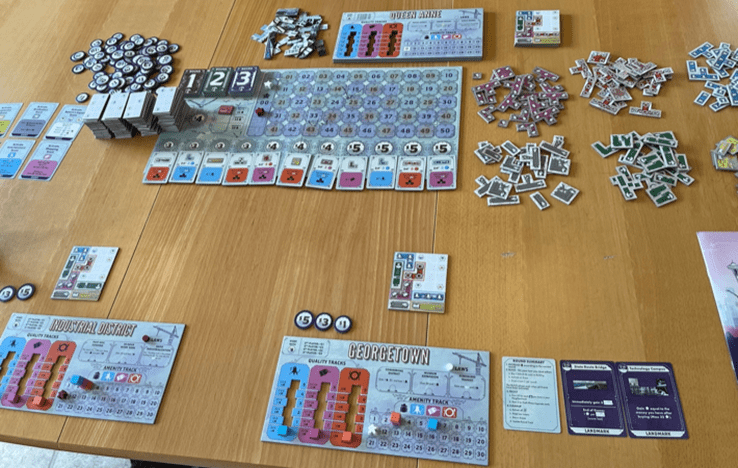
Buildings and upgrades are acquired by buying cards from a shared market – each card grants a unique combination of a building and upgrade, and the cards are laid out on a market board with variable prices. This means that some cards are strictly a better deal than others, and this leads to players competing to identify the best deals and snatch them up. The effects of most of the buildings are tied to Event cards – these are actions that impact all players and provide a special benefit for the player that activates them. Victory points are scored from three main sources: Quality Tracks, built Landmarks, and end of game upgrades.
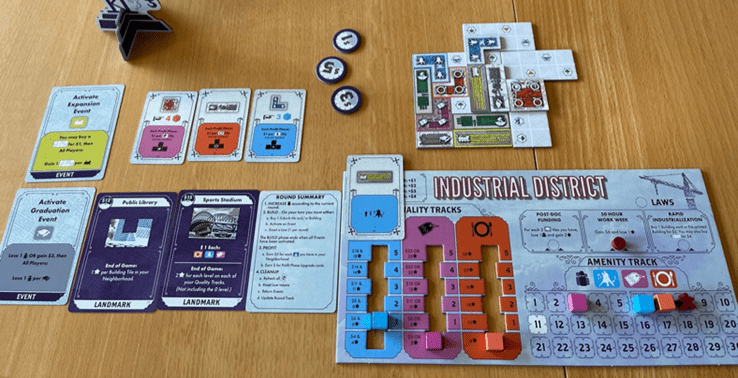
The core mechanic of the game revolves around population – players have a population that grows rapidly throughout the game, and each of their population wants their own amenity (they don’t like to share). There are three types of amenities – Restaurants, Entertainment and Shops – and they all pay out rewards in different ways. If a player succeeds in providing enough amenities for their population when the associated Event triggers, they get rewards based on the quality of that amenity – this quality can be improved via upgrades. The game ends after three rounds, and the player with the most victory points wins!
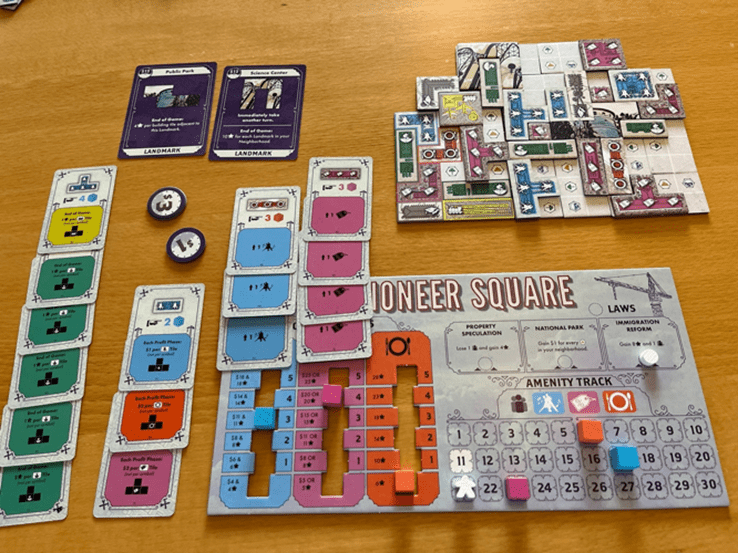
Here’s what a player’s neighborhood looks like at the end of the game:
WizKids: What are the exciting moments you find when playing?
Quinn: I find it exciting when I see a building card that works really well for my neighborhood and I want to buy it, but then I take a look around the table and conclude that it’s probably not a first-choice card for the other players, so instead I take a risk and buy my second choice of card instead. If I hear a groan from another player, I know I made the right choice 😀
Another satisfying moment is when I need an event triggered this round, but then I realize that I don’t actually have to trigger it myself – another player is probably going to trigger it for me if I don’t, and that it’s better for me to buy another card or enact a law instead.
In Rebuilding Seattle, it’s quite easy to grok other player’s boards and make educated guesses about what they’re going to do next, and this can allow you to optimize your strategy in interesting ways.
WizKids: What are the types of tough decisions players have to make?
Quinn: When deciding what building card to buy from the market, there’s a few key considerations – what building type/s do you need right now, what upgrades are best for you, and what cards are cheapest? It’s rare that a card is going to have exactly what you want to buy at the cheapest price, so you end up weighing options – is it better to spend $5 on exactly the right combination of building and upgrade, or should you spend $3 to get a non-ideal combo? When you layer on the consideration that the building’s size impacts its in-game utility, and that the building can fit on your board in more or less ideal ways, you end up with a lot to think about.
On your turn, when you buy a building card, you can also buy a suburb at the same time. This is nearly always a hard decision to make. To buy a suburb at the same time is more efficient, in that it allows you to convert more of your money into resources on that turn, and it also immediately gives you additional terrain symbols and building space which can have a big impact. However, buying suburbs outright is also really expensive and suburbs aren’t nearly as strong as building cards in terms of comparing game effects to dollars spent. In many cases, it’s better to only buy building cards because it allows you to do more with less money over the course of multiple turns – especially if you have a few train tiles already. But, if you have more money than the other players, you probably won’t have enough turns in a round to spend all of that money. So, this seemingly simple, recurring decision ends up being quite tactically rich and often does impact who wins.
The decision to pursue one Quality Track or two Quality Tracks is also quite interesting. It’s safer to focus on just one, but the maximum payout is better if you go after two Quality Tracks instead. This decision has a lot to do with how well the other players are doing – if it’s a prosperous game, two Quality Tracks is usually the way to go, since you’ll have enough turns to profit from both. But if one of the players is cash poor, they often cause rounds to end early, and then one Quality Track is your best bet. In some very special games, you can even successfully pursue all three Quality Tracks by going all in on education tiles!
WizKids: Describe your design philosophy.
Quinn: For me, the theoretical perfect game is deeply thematic, built around a small number of intuitive rules, and each turn has players choosing between a small number of actions, where each action is compelling and meaningfully different. This theoretical game has a wide player count, plays in 90 minutes, has no set up or tear down, and plays wildly differently each game. There is input randomness but no output randomness. There is no player elimination, no downtime, and all players feel that they have a chance of winning right up until the end. The game retail price is low, and yet, the box contains tons of components. All of these components are used each game, but always in different ways. There is almost no text, and yet, the events of the game tell their own emergent narrative. At the end of the game, each player feels that they made clever and creative plays, had a great time, and is proud of their unique board and asymmetrical strategy. They, of course, want to play again right after. My goal is to try to create designs that get closer to this platonic ideal of a game, which will of course never be fully achieved, being a mere abstraction.
WizKids: What has the process been like for you taking your game from the drawing board to its final stages? Were there any fun and unexpected moments of discovery as you were designing it?
Quinn: Definitely. I made many discoveries during this game’s long development cycle, and if I tried to catalog them all I expect I would wear out most readers’ attention, so I won’t do that. Instead, here are some of the highlights:
The first version of the game featured a negative victory track where players were trying to avoid scoring points, and the player with the least points at the end of the game won… it was a very different game. It looked like this at the time, to give some context:
What I discovered is that players don’t like it when bad things happen to them, even in a board game. Over the years I removed more and more of the punishing mechanics and replaced them with rewarding mechanics, and reception warmed every time I did this, until eventually the entire design philosophy had flipped on its head. I think that there’s something about human nature that craves progression and improvement over time. I’ve learned not to fight against that in my designs.
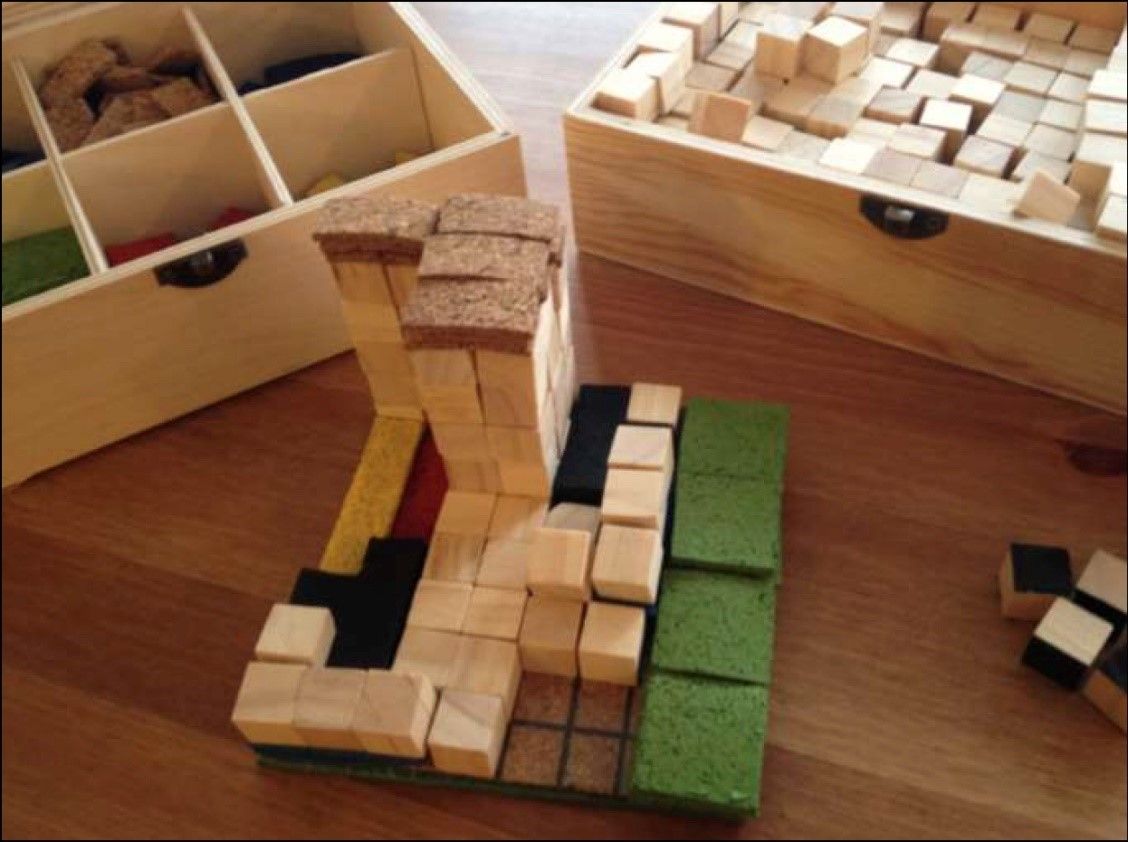
For the longest time, the design was structurally pinned to the exponential doubling of these wooden cubes you see in the photo. They doubled in number each round – players started with 1, then they had 2, then 4, then 8, all of the way to 64 cubes! I was so enamored by the elegance of this exponential growth and the physicality and table presence of the wooden cubes that I took to ignoring the negative impacts they were having on the player experience. The main issues with this design were:
- players don’t understand or enjoy exponential growth
- counting and doing math with 64 cubes is a fiddly nightmare
- the rigidity of the doubling logic made it not tunable, which meant every other aspect of the game had to try to prop up this rigid mathematical structure. This led to all sorts of weirdness in the player experience like wildly different end game scores
Eventually, I abandoned both the cubes and the doubling and the game was far better for it (though it hurt to scrap the cubes, they were so cute!).
Another big discovery was when I realized that all of the tiresome upkeep rules that I had players doing at the end of each round, like reducing their population from their education tiles and scoring their restaurants, could be turned into active actions by transforming them into event cards that give bonuses to the player that activates them. Eureka!
Another was when I introduced the idea of suburbs that expand your board. It probably seems obvious now, but for the longest time, players started with an 8×8 board that never grew in size, and they had to use the space they were given wisely. For many years the game was built on top of this assumption, which succeeded in introducing stakes, to be sure, but also, a feeling of claustrophobia. The moment I introduced board expansion through trains that grant suburbs, the whole feel of the game became a lot more freeing and I never looked back.
The final big discovery was the Landmarks. Before then, instead of the Landmarks, there were these ‘Super Building Cards’, which were expensive, provided a normal building, and had a powerful end of game bonus. Also, they were in the market for anyone to buy. They played a similar kind of role to today’s Landmarks, but with some notable differences: since anyone could buy them, multiple people would often be working towards buying the same Landmark, and then the player(s) that failed to buy it had their game’s grand strategy totally thrown off and it was a real feel-bad moment. Also, I eventually realized that using normal buildings was a totally wasted opportunity – they could and should be big, flashy polyomino shapes. Compared to the Super Building Cards, today’s Landmarks feel more unique, more powerful, and because you start with them, you can count on being able to build them, and all of this leads to a much better experience.
WizKids: What were the biggest challenges you faced?
Quinn: One of the biggest challenges in my life so far was my transition from my previous career as a cellist to that of a game designer. This transition happened while I was in the early stages of designing Rebuilding Seattle, and the game helped to anchor me through that transition, in that I felt that it was a good design and it helped assure me that my becoming a game designer was a viable career path and not just a flight of fancy.
The other big challenge associated with the design of Rebuilding Seattle was when a different publisher signed, and then later, dropped the title (kindly giving me back the rights to it in the dropping). At the time, it felt like I had wasted years of effort on this design that was ultimately going nowhere. But instead of abandoning the project or jumping back into shopping my design around to other publishers, I decided to take the harder path and assume that the publisher was wrong to drop the game, but was right that it wasn’t yet as good as it could be. That was ultimately the right decision, as it allowed me to question some basic assumptions I had about the design which led to some dramatic improvements. The version of the game that the first publisher might have published is far less good than today’s game, so to take the long view of it, them dropping my game ended up being the best thing that could have happened to it.
WizKids: What has it been like working with WizKids?
Quinn: It’s been wonderful all around. Zev Shlasinger has excellent judgement and an incredible track record in the industry, and it’s thanks to him that WizKids took a chance on this game, and a big chance at that. The UX, art, graphic design and rulebook are all top shelf, and given that I’m a first-time board game designer, it’s more than I could have hoped for. WizKids is also great at communicating with designers, and that is so nice and so rare in our industry, unless you’re already a well-known figure. My recommendation to other designers is that, if you have a polished, quality prototype, try to attend a convention that Zev is at and get him to play it. Regardless of whether he likes it, he always gives really insightful feedback. If it really is polished, you can reach out to me too – if it’s on Tabletop Simulator or Tabletopia I’ll play it with you and tell you what I see.
WizKids: What types of players might enjoy Rebuilding Seattle the most?
Quinn: If you enjoy games like Wingspan, Patchwork, Catan, Suburbia, Castles of Mad King Ludwig, or A Feast for Odin, then I think Rebuilding Seattle is in your wheelhouse. It’s a gateway euro in that its rules complexity is low, but it’s got quite a bit of depth to the strategy and you can sink your teeth into it.
WizKids: Are you working on any other projects you can tell us about?
Quinn: I’m working on two prototypes at the moment, both co-op games, though they’re quite different from each other. I don’t want to say too much about them at this time, except that I expect that neither of them will be ready to be published for at least another few years. I’d rather design 2 great games than 10 good ones, and my experience developing Rebuilding Seattle has shown me that the quality of my designs are heavily influenced by the time I devote to developing them.
If you enjoyed this design diary and want to hear more, you can follow Quinn on Hive Social at @quinnbrander
Need to play this ASAP? Pre-Order the game here: Shop.WizKids.com
Going to PAXU in Philly this December? Demo the game with Quinn in event Hall C #TT-13 on Saturday Dec. 4th from 1:00pm – 3:00pm, or swing by the WizKids booth #2437 to learn more.